
Turkey Cooking Time by Weight, Method, and Stuffing
Plan roast turkey time by weight and method, understand stuffed versus unstuffed timing, and finish safely through verified thermometer checks.
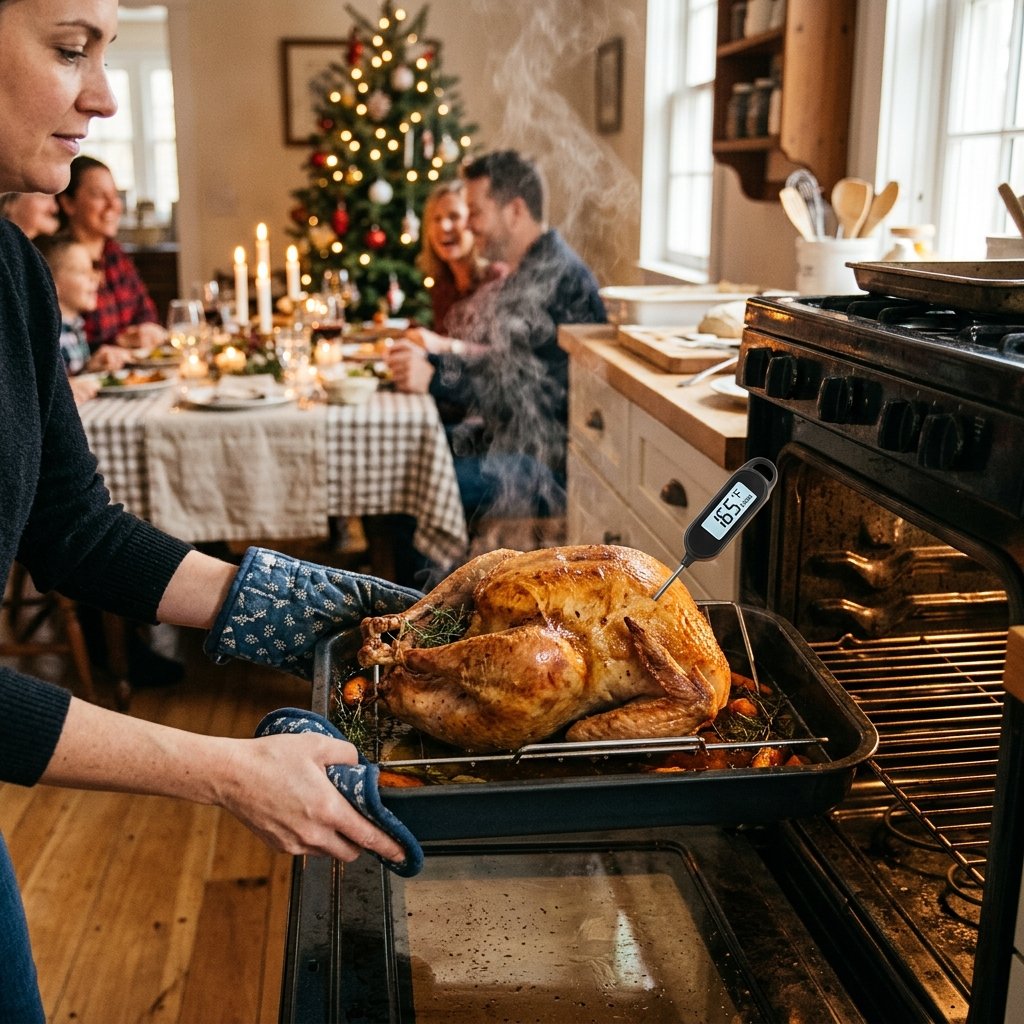
Accurate holiday timing depends on calculating your turkey’s cooking schedule around thermal science rather than rigid clock guesswork. Factors such as oven calibration, starting internal meat temperature, roasting vessel depth, and stuffing all significantly alter total oven duration.
At a conventional roasting temperature of 325°F (163°C), an unstuffed whole turkey typically requires 13 to 15 minutes per pound. A stuffed bird requires 15 to 18 minutes per pound to ensure the core reaches food-safe temperatures. However, weight-based time estimates must always serve as planning benchmarks, with final doneness determined exclusively by a calibrated meat thermometer reading 165°F (74°C).
Master Roasting Timetable (Conventional Oven at 325°F / 163°C)
The following matrix provides baseline planning hours for fully thawed, unstuffed and stuffed whole turkeys roasted in a conventional oven:
| Whole Turkey Weight | Unstuffed Roasting Time | Stuffed Roasting Time | Est. Minutes / Pound |
|---|---|---|---|
| 8–12 lbs | 2 hrs 45 min – 3 hrs | 3 hrs – 3 hrs 30 min | 14–15 min/lb |
| 12–14 lbs | 3 hrs – 3 hrs 45 min | 3 hrs 30 min – 4 hrs | 14–15 min/lb |
| 14–18 lbs | 3 hrs 45 min – 4 hrs 15 min | 4 hrs – 4 hrs 30 min | 13–14 min/lb |
| 18–20 lbs | 4 hrs 15 min – 4 hrs 30 min | 4 hrs 30 min – 4 hrs 45 min | 13–14 min/lb |
| 20–24 lbs | 4 hrs 30 min – 5 hrs | 4 hrs 45 min – 5 hrs 15 min | 12–13 min/lb |
To calculate an exact serving schedule with backwards-planned oven start times, use our Turkey Cooking Time Calculator.
Why Stuffing Alters Cooking Physics
The USDA strongly advises cooking stuffing in a separate casserole dish rather than packing it inside the bird’s raw cavity. The reasons are rooted in thermodynamics and food safety:
- The Cold Core Problem: Stuffing absorbs raw poultry juices while remaining insulated deep in the coldest center of the bird.
- Thermal Lag: Even when breast meat and thighs reach 165°F, dense bread stuffing may still register below 140°F, creating a fertile breeding ground for Salmonella.
- Overcooked Breast Meat: Waiting for internal stuffing to hit a safe 165°F often forces you to leave the bird in the oven an extra 30 to 45 minutes, inevitably drying out the white breast meat.
If you choose to cook a stuffed turkey, stuff the bird loosely immediately before placing it into the preheated oven (never hours in advance), and ensure your thermometer probe confirms that the center of the stuffing reaches a minimum of 165°F (74°C).
Choosing Your Oven Temperature: 325°F vs 350°F vs High-Heat
Different roasting styles balance cooking velocity against moisture retention:
1. Slow and Steady: 325°F (163°C)
- Best for: Whole traditional birds larger than 16 pounds.
- Characteristics: Gentle heat allows thick dark meat muscles to reach tender temperatures without scorching outer breast skin. Provides the widest margin for error.
2. Balanced Roasting: 350°F (177°C)
- Best for: Average-sized birds (12 to 16 pounds) and bone-in breasts.
- Characteristics: Cuts total cooking time by approximately 20 to 30 minutes while promoting golden skin through the Maillard reaction.
3. High-Heat Roasting: 400°F–425°F (204°C–218°C)
- Best for: Spatchcocked (flattened) birds or smaller whole turkeys under 12 pounds.
- Characteristics: Rapid cooking (often under 80 minutes) with blistered, ultra-crispy skin. Requires continuous monitoring to prevent butter or fat from smoking.
Convection Oven Adjustments
Convection ovens circulate hot air continuously using an internal fan, stripping away the thin layer of cold air that naturally surrounds cool poultry. When using a convection oven:
- Lower the Temperature: Reduce the set temperature by 25°F (e.g., set to 300°F instead of 325°F).
- Shorten the Duration: Plan for cooking times to be approximately 20% to 25% faster than conventional oven estimates. Begin checking temperatures at least 45 minutes earlier than scheduled.
Multi-Point Thermometer Verification
Relying on pop-up timers or visual skin browning frequently results in either undercooked poultry or chalky, dry meat. Use a calibrated digital probe thermometer to check three separate points:
- Deepest Area of the Breast: Insert horizontally into the thickest muscle lobe. Must register 165°F (74°C).
- Inner Thigh Muscle: Insert into the thickest area of the thigh without hitting the bone. Dark meat is safe at 165°F, but connective tissue breaks down best between 175°F and 180°F (79°C and 82°C).
- Thickest Wing Joint: Verify the wing shoulder registers at least 165°F (74°C).
Account for carryover cooking during resting. Large whole turkeys (16+ pounds) typically gain 5°F to 8°F of internal heat during their 30-to-40-minute post-oven rest, so pulling the bird at 160°F in the breast will comfortably achieve the safe 165°F target before slicing.
Sources
- Safe Minimum Internal Temperature ChartUSDA Food Safety and Inspection Service · Verified 2026-08-06
The 165°F (74°C) minimum internal temperature for poultry and stuffing.
- Turkey Roasting TimetableUSDA Food Safety and Inspection Service · Verified 2026-11-03
Conventional oven roasting timetables, temperature management, and stuffing safety.