
The Perfect Turkey Temperature: A Complete Guide
Learn the ideal internal temperature for safely cooking your turkey to perfection every time.
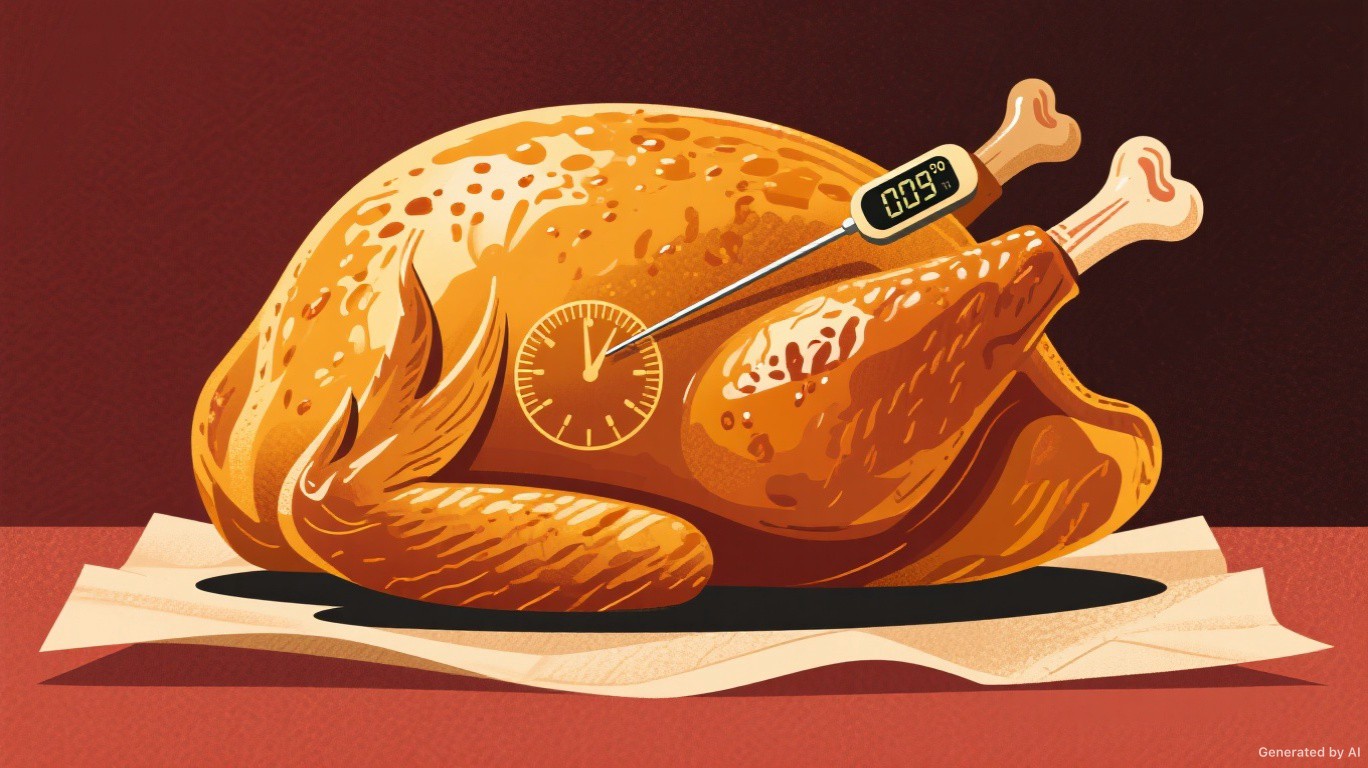
Getting the perfect turkey starts with knowing the right temperature. The USDA recommends cooking turkey to an internal temperature of 165°F (74°C) for food safety. Time and oven temperature help you plan, but only a thermometer can tell you when the bird is ready.
Turkey can look browned before the center is safe, or remain pale while the internal temperature is already high enough. Build your cooking plan around temperature checks rather than color, juices, or a pop-up timer.
Where to Measure
Insert the thermometer into the thickest part of the breast, the innermost thigh, and the innermost wing without touching bone. The thigh often takes longer than the breast, while the breast can dry out if you wait too long after it reaches its target.
For a whole turkey, take the reading from the side of the meat so the probe reaches the center of the thickest section. Check more than one location because oven hot spots, bird shape, stuffing, and probe placement can create different readings.
When to Start Checking
Begin checking before the recipe’s estimated finish time. A 14-pound unstuffed turkey may finish before a 16-pound stuffed turkey even when both use the same oven temperature. Start with the thickest areas, close the oven quickly, and continue cooking if any location is below 165°F (74°C).
Resting Time Matters
After removing from the oven, let your turkey rest for 20–45 minutes depending on its size. The internal temperature may continue to rise by several degrees, and the juices redistribute throughout the meat. Resting also makes carving cleaner and gives you time to finish gravy and side dishes.
Resting does not replace the food-safety target. The turkey needs to reach 165°F (74°C) in the checked locations; do not remove a significantly undercooked bird assuming the rest will solve it.
Tips for Success
- Use a reliable meat thermometer
- Check multiple spots to ensure even cooking
- Don’t rely on pop-up timers alone
- Keep your oven temperature steady at 325°F
- Clean the probe with hot soapy water before and after use
- Check the thermometer in ice water or boiling water according to the manufacturer’s instructions
- Insert the probe away from bone, the cavity, and the pan
Breast Versus Thigh
Breast meat is lean and can become dry when it is held at high temperatures for too long. Thigh meat contains more connective tissue and is often more forgiving. Check both areas and use the lower reading as the decision point for safety, while avoiding an unnecessarily long hold after the breast is already well above target.
Stuffed Turkey
If the turkey is stuffed, check the center of the stuffing as well as the bird. The stuffing must reach 165°F (74°C), and it often takes longer than the surrounding meat. For the simplest temperature control and shorter cooking time, cook stuffing separately.
Why Time Charts Still Matter
Cooking-time charts are useful for scheduling oven use, resting, and serving. They cannot account perfectly for starting temperature, pan material, oven calibration, bird shape, stuffing, or how often the door opens. Use the Turkey Cooking Time Calculator for a starting estimate, then finish by temperature.
Final Temperature Checklist
- Check the thickest breast area.
- Check the innermost thigh.
- Check the innermost wing.
- Check the stuffing center if the bird is stuffed.
- Continue cooking any area below 165°F (74°C).
- Rest the turkey before carving and refrigerate leftovers promptly.
Master these basics and you will have a safer, juicier, more predictable turkey dinner without relying on an unreliable clock.
Sources
- Safe Minimum Internal Temperature ChartUSDA Food Safety and Inspection Service · Verified 2026-08-06
The 165°F (74°C) minimum internal temperature for poultry and stuffing.