
Spatchcock Turkey Guide: Preparation, Time, and Temperature
Learn when to spatchcock a turkey, how flattening changes cooking time, what equipment you need, and where to check temperature.
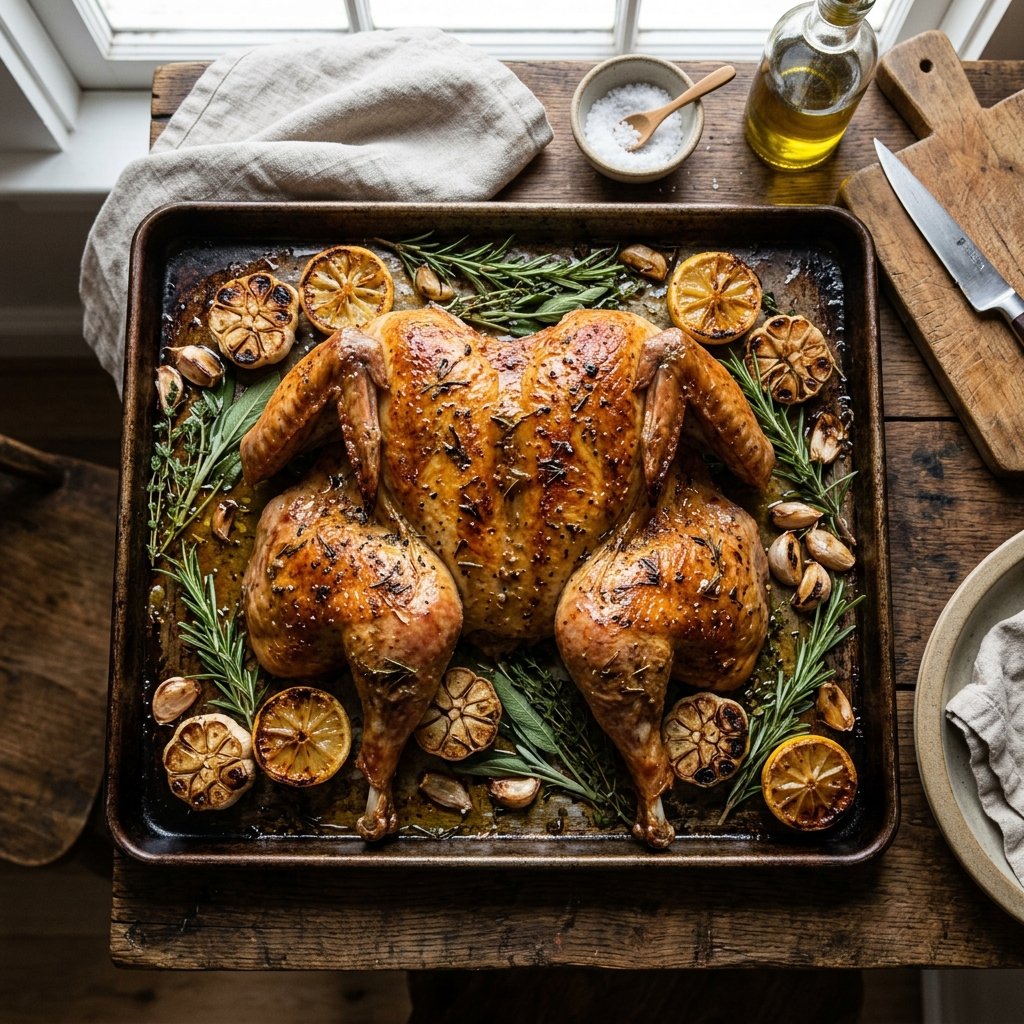
Spatchcocking—also known as butterflying—is one of the most effective culinary techniques for roasting a whole turkey. By removing the bird’s backbone and flattening the breast and leg quarters onto a single horizontal plane, you solve the fundamental dilemma of holiday poultry: how to cook dark leg meat to a tender 175°F without turning lean white breast meat dry and chalky.
Flattening the turkey cuts roasting time by approximately 25% to 35%, allows direct exposure to circulating oven heat, and ensures that nearly 100% of the skin faces upward toward radiant dry heat for superior browning.
Why Spatchcocking Works: The Thermal Physics
In a conventional trussed whole turkey, the bird resembles a thick, hollow sphere. Hot oven air circulates around the outside, while heat struggles to penetrate the cavernous interior cavity. As a result, the delicate breast meat sits elevated near the hottest part of the oven for three to four hours while the dense thigh joints remain buried underneath.
When you spatchcock a turkey:
- Uniform Horizontal Plane: Both white and dark meat cook on the same level, receiving balanced radiant and convective heat.
- Exposed Thighs: The legs splay outward to the perimeter of the pan where oven airflow is strongest, allowing dark meat to cook faster than the central breast.
- No Steam Trapping: Without a sealed internal cavity, moisture vents outward freely instead of steaming breast meat from underneath.
- All Skin Faces Upward: Traditional roasting leaves the underside skin pale, rubbery, and soggy. Spatchcocking exposes the entirety of the outer skin to hot dry air.
Required Equipment
Butterflying poultry requires sturdy, high-leverage tools capable of cutting through thick rib and vertebral bones:
- Heavy-Duty Poultry Shears: Essential. Standard kitchen scissors will bend or jam against heavy turkey ribs. Look for spring-loaded shears with serrated bone-notched stainless blades.
- Rimmed Baking Sheet (Half-Sheet Pan): An 18x13-inch rimmed aluminum baking sheet provides sufficient surface area for birds up to 16 or 18 pounds.
- Stainless Wire Roasting Rack: Placing a wire rack inside the sheet pan elevates the meat slightly, allowing air to circulate underneath and keeping fat drippings separated.
- Paper Towels: Essential for thoroughly drying the cavity and skin before cutting and seasoning.
Step-by-Step Butterflying Instructions
Ensure the turkey is completely thawed before attempting to spatchcock. Cutting into partially frozen cartilage or bone can cause shears to slip.
Step 1: Position and Dry the Bird
Remove giblets and neck from the cavities. Thoroughly pat the turkey dry inside and out with paper towels. Place the turkey breast-side down on a stable cutting board, with the tail facing toward you.
Step 2: Remove the Backbone
Locate the backbone running down the exact center of the bird. Starting at the tail end, use your heavy-duty poultry shears to cut along one side of the spine, staying about 1/2 inch from the center line. Cut completely through the rib cage from tail to neck. Repeat the cut along the opposite side of the spine to remove the backbone entirely. Reserve the backbone in the freezer for making rich holiday gravy stock.
Step 3: Crack the Keel Bone
Flip the turkey over so it rests breast-side up, with the drumsticks pointing outward. Place the heels of both hands firmly over the center of the breastbone (keel bone). Lean over the cutting board and press down firmly until you hear a sharp snap. This flattens the cartilage and allows the turkey to lie completely flat on the roasting rack.
Step 4: Arrange Wings and Legs
Tuck the wing tips behind the shoulder joints to prevent the slender tips from scorching during roasting. Rotate the drumsticks so they point inward toward the breast, creating an even, compact rectangle on your baking sheet.
Cooking Times and Temperatures
Because a flattened bird exposes much more surface area to ambient heat, you can roast at higher temperatures (400°F to 425°F / 200°C to 220°C) without burning the skin before the interior reaches safety thresholds.
| Turkey Weight | Oven Temp | Estimated Cook Time | Target Breast Temp | Target Thigh Temp |
|---|---|---|---|---|
| 10–12 lbs | 425°F (218°C) | 60–75 minutes | 165°F (74°C) | 175°F (79°C) |
| 12–14 lbs | 425°F (218°C) | 70–85 minutes | 165°F (74°C) | 175°F (79°C) |
| 14–16 lbs | 400°F (204°C) | 80–95 minutes | 165°F (74°C) | 175°F (79°C) |
| 16–18 lbs | 400°F (204°C) | 90–110 minutes | 165°F (74°C) | 175°F (79°C) |
Calculate your exact timeline with our Spatchcock Turkey Time Calculator.
Verifying Safe Internal Temperatures
Never rely solely on elapsed clock time. Verify donor readiness with a calibrated digital instant-read thermometer:
- Thickest Area of Breast: Insert the probe horizontally into the deepest part of the breast muscle, avoiding bone contact. The safe target is 165°F (74°C).
- Deep Thigh Joint: Insert the probe into the innermost joint between the thigh and drumstick without touching the femur. While 165°F is safe, dark meat achieves superior tenderness and melted collagen at 175°F to 180°F (79°C to 82°C).
Advantages and Tradeoffs
Advantages
- Substantial Time Savings: Shaves 60 to 90 minutes off standard holiday roasting schedules, freeing up oven capacity.
- Superior Crispy Skin: Maximized dry heat contact eliminates pale, soggy skin.
- Effortless Carving: A flat bird requires minimal maneuvering on the cutting board compared to a tall, unwieldy whole carcass.
Tradeoffs
- Oven Footprint: A flattened 16-pound turkey occupies the full width of an 18x13-inch baking sheet, which may limit space for multiple side dishes on the same oven rack.
- No Traditional Presentation: You sacrifice the classic Norman Rockwell tableside presentation of a tall, whole roasted bird.
- Weight Ceiling: Birds over 18 to 20 pounds are unwieldy to butterfly and rarely fit within home residential ovens once flattened. For large parties, roasting two smaller 12-pound spatchcocked birds on separate racks is faster and more reliable.
Sources
- Safe Minimum Internal Temperature ChartUSDA Food Safety and Inspection Service · Verified 2026-08-06
The 165°F (74°C) minimum internal temperature for poultry and stuffing.